BLSK Energy

Energy Independence. Measured in Centuries.

America has more than 95,000 metric tonnes of used nuclear fuel. When recycled using BLSK's technology, it's enough to power the nation for hundreds of years. No foreign enrichment. No foreign dependency. Already on American soil.

Proven through more than 60 years of R&D at Argonne National Laboratory. BLSK Energy is commercializing it.

The Untapped Resource

99.4%

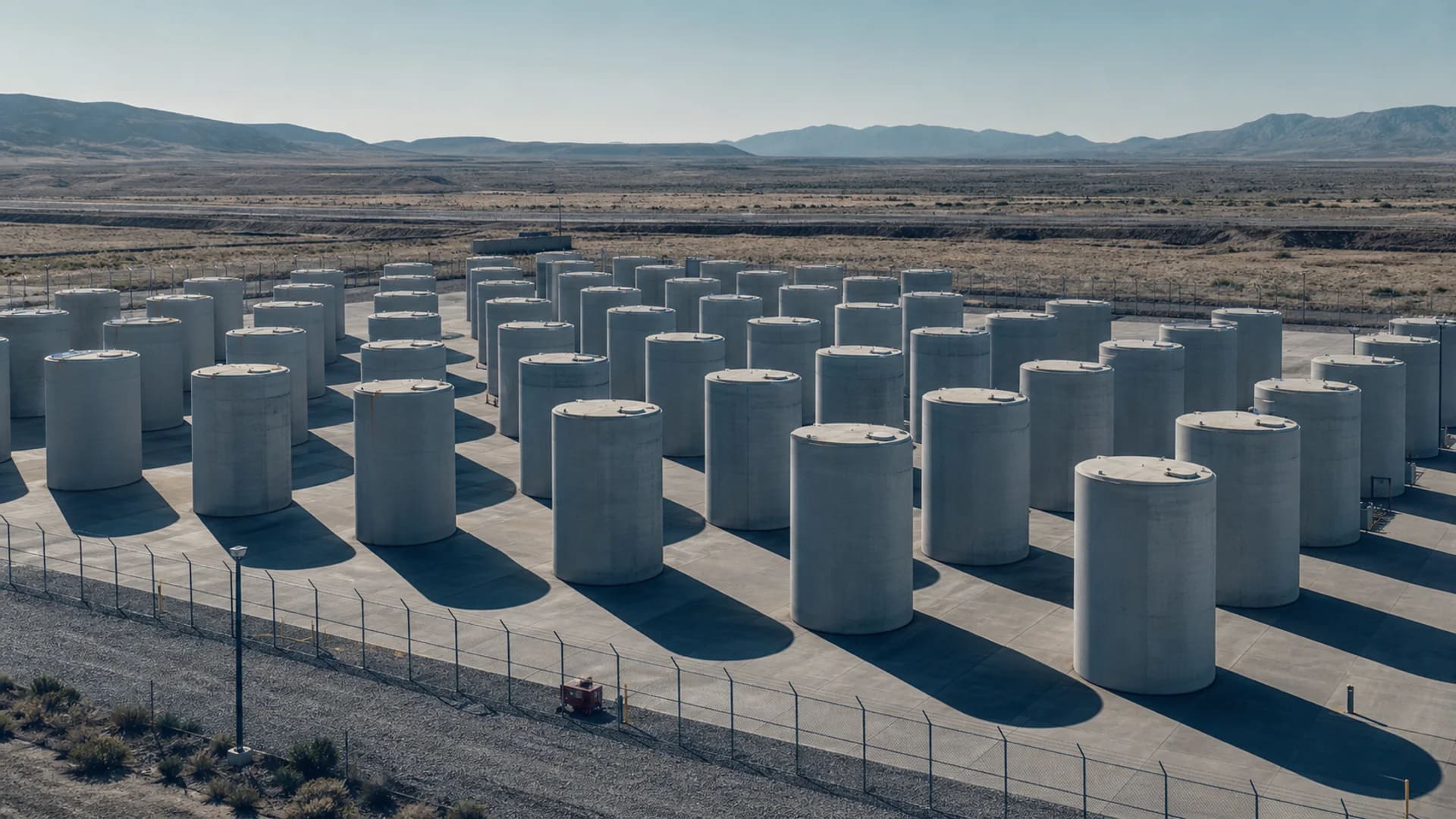
In today's once-through fuel cycle, American reactors use about 0.6% of the total energy potential in mined uranium. Discharged fuel assemblies still retain roughly 95% of their original energy value, yet we store them in concrete casks and call them waste.

Source: DOE Office of Nuclear Energy; Chang 2026

Foreign Dependency

95%

Imports account for roughly 95% of the enriched uranium America uses to make nuclear fuel, with more than one-third historically coming from Russia. Meanwhile, more than 95,000 tonnes of recyclable fuel sits in American storage. Pyroprocessing and fast reactors can replace that dependency with domestic energy.

Source: EIA uranium enrichment data

The Cost and Availability Gap

New advanced, fast reactors require High Assay Low Enriched Uranium (HALEU) as fuel. But it is expensive, in short supply, and constrained by foreign enrichment capacity, including Russian services. Using its proprietary technology, BLSK Energy plans to produce an abundant supply of HALEU-equivalent metal fuel at a fraction of the $25,000/kg it costs today.

Source: BLSK Energy Reference Fact Sheet; DOE HALEU program

Energy Density

3,000,000×

One metric tonne of used nuclear fuel contains roughly the energy equivalent of 3 million tonnes of coal. America has more than 95,000 of them sitting in storage. The Strategic Petroleum Reserve holds 700 million barrels of oil — the energy in America's used nuclear fuel dwarfs it.

Source: DOE Office of Nuclear Energy; first-principles fission physics

Independent Validation

In May 2026, McKinsey & Company published a comprehensive analysis of the U.S. nuclear fuel supply chain, finding that $105 billion to $170 billion in total investment is needed to achieve domestic fuel production goals by 2050 — including $20 billion to $45 billion for fuel reprocessing alone.

McKinsey & Company, "Understanding Domestic Nuclear Fuel Production Options in the United States," May 2026

What We Do

BLSK Energy has exclusive access to Argonne National Laboratory's intellectual property and a detailed conceptual design for the first pyroprocessing Pilot Facility. It is commercializing this proven process that converts used nuclear fuel into HALEU-equivalent metal fuel for advanced fast reactors. Our approach reduces America's dependence on foreign uranium enrichment and turns a $2-million-per-day storage liability for used nuclear fuel into centuries of domestic energy.

The Origin Story

In 1977, President Carter banned nuclear fuel reprocessing in the United States. Four commercial reprocessing plants — including one that would have been the world's largest — were shut down or abandoned. At Argonne National Laboratory, the scientists who'd spent their careers on fast reactor technology faced a choice: give up, or reinvent the approach entirely.

They chose to reinvent. What emerged was the Integral Fast Reactor and pyroprocessing — a fundamentally new way to recycle nuclear fuel that was simpler, cheaper, safer, and more proliferation-resistant than anything that came before. They proved it worked. They closed the fuel cycle at engineering scale at the EBR-II Fuel Conditioning Facility, which has operated continuously since 1996.

In 1994, the program was cancelled — not for technical reasons, but political ones. Thirty years later, the policy has reversed. The technology is ready. And America needs it more than ever.

BLSK Energy is the company built to deliver what Argonne created.

Institutional Partnerships

  • Exclusive access to Argonne National Laboratory's pyroprocessing conceptual design through CRADA (No. A25591)
  • Principal Investigator: Dr. Yoon Il Chang, Argonne National Laboratory
  • Architect-Engineer: Merrick & Company
  • Teaming agreement with EnergySolutions for site selection, advisory, and other services
  • Member of EnergySolutions-led DOE Nuclear Lifecycle Innovation Campus consortium
Argonne National Laboratory
Merrick & Company
EnergySolutions
An American energy future powered by nuclear fuel recycling

American energy independence isn't a slogan. It's more than 95,000 metric tonnes of fuel, a proven technology, and the will to use them.